Before Postcards, the Travel Souvenir Took Many Forms
Travel souvenirs before postcards included objects, images and written accounts. See how those forms served different purposes without reducing travel to a keepsake.
The common mistake in tracing travel souvenirs before postcards is treating every keepsake as part of one tidy tradition. A devotional token, a purchased craft and a traveller’s sketch had different purposes, and folding them into a single story can blur what each meant. A more careful view starts with the particular object and the person who carried it.
There is no need to claim that one kind of souvenir replaced another. Travellers have used objects, images and writing in different combinations; which forms mattered depended on the journey, the traveller and the intended audience. That distinction makes the history more useful than a simple march towards the postcard.
What did a travel souvenir mean before postcards?
The word “souvenir” points to remembering, but it does not describe one fixed kind of thing. A reminder might be bought, made, received or written down. Its importance could come from its use, its connection to a place or the memory attached to it later.
It is safer to describe particular contexts than to suggest a single history for all travellers. For instance, religious travel could involve tokens connected with a sacred destination, while a visitor might bring home a locally made object. These examples are not interchangeable: one may carry devotional meaning, while another may be valued for its craft or practical use.
Natural objects and architectural fragments also appear in accounts of travel collecting, but a mention of collecting does not make removal acceptable. Rules differ by site, and a shell, stone or plant may belong to a protected place or habitat. A drawing or photograph can serve as a reminder without taking anything from it.
Why did travellers bring back objects, pictures and words?
Each form carried a different kind of meaning. A useful object could enter daily life at home; a picture could preserve the appearance of a view; writing could record an impression or explain why an object mattered. None had to provide a complete account of a journey.
A keepsake can be hard to interpret without its story. A cup on a shelf may prompt its owner to remember a market, while someone else sees only a cup. A label, letter or journal entry can connect the object to its maker, setting or occasion.
Drawings and descriptions had their own limits. They reflected what the traveller noticed and chose to record, rather than offering a neutral picture of an entire place. That personal viewpoint is part of their value, but it also means they should not be treated as comprehensive records.
How did the postcard bring familiar functions together?
A postcard combined an image with a short message that could be sent to another person. That made it a convenient way to share a view and a few words, but it did not make other forms of remembrance obsolete. Travellers could still keep objects, make drawings or write longer accounts.
It is useful to distinguish the postcard’s format from the broader practice of remembering a journey. A postcard could show a scene to someone at home; a privately kept object might matter chiefly to its owner. The same trip could produce both, with each serving a different audience.
How can you choose a reminder without turning travel into collecting?
Start by deciding what you want to remember, rather than assuming you need to buy something. If the detail is a view, a photograph or sketch may suit it. If it is a conversation, a few words written afterwards may be more fitting; if it is an object’s craft or use, a locally made item may carry that connection, provided buying and carrying it are appropriate.
Before taking or buying anything, check the relevant site rules and consider whether the item is genuinely offered for sale. If the setting is protected, fragile or unclear, leave natural and historic material where it is. A reminder does not need to become a possession.
- Check whether an item is being sold by a maker or a clearly identified shop; if its origin is unclear, ask before buying, then choose another reminder if you cannot establish where it came from.
- Check the site’s signs or official guidance before removing a natural object; if collecting is prohibited or uncertain, leave it in place and use a photograph or sketch instead.
- Check whether a fragile object can travel safely in your luggage; if it cannot, ask about suitable packing or choose a smaller, sturdier item.
- Check whether you can recall why a particular object caught your attention; if the reason is hard to name, pause before buying and consider writing down the detail instead.
- Check whether a picture captures the feature you want to remember; if it misses the sound, conversation or atmosphere, add a short note rather than taking more images.
- Check whether another person would welcome being photographed or recorded; if you have not asked or cannot tell, keep the moment private and make a note afterwards without identifying details.
Which kind of reminder suits a particular memory?
What can replace a postcard when you want to remember a view?
A sketch can preserve the way a street or landscape is arranged, while a photograph can retain its colours and light. A short caption can explain what drew your attention to the scene.
How can you remember a conversation without recording it?
Afterwards, write down a phrase or gesture you still recall and the general setting. Keep the note focused on your own impression rather than presenting it as the other person’s full story.
Should you take a natural object home?
Check the site rules before collecting anything, since protected places and fragile habitats may have restrictions. If the guidance is unclear, leave the object where it is and draw or photograph it instead.
What makes a bought souvenir feel personal?
A clear connection to a maker, use or particular encounter can give an object meaning beyond a place-name. A brief note about that connection can help you remember why you chose it.
How might different reminders work together on one journey?
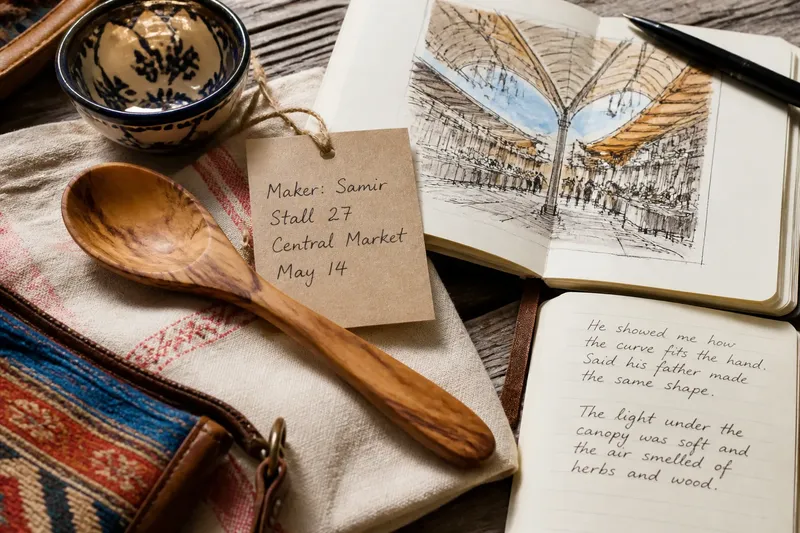
Imagine you visit a covered market and have a small, hypothetical budget for a keepsake. You notice a locally made wooden spoon, hear its maker explain its shape, and like the pattern of the market canopy. First, you check that the spoon is being sold by its maker and that you can carry it safely; then you buy it, write the maker’s name and stall location on a note, and sketch the canopy in your notebook. The resulting set is modest: the spoon recalls its use, the note keeps the encounter attached to it, and the sketch records the setting. If the spoon’s origin or safe transport remains unclear, the trade-off is simple: skip the purchase and keep the note and sketch instead.
This is not a claim that one combination suits every traveller. It shows why older forms of travel remembrance are best considered by purpose: a picture, an object and a written account preserve different parts of an encounter. Thinking in those terms makes the history of travel souvenirs before postcards less about collecting and more about how people chose to carry a journey in memory.
If you bring an object home, keep its story close to it: a handwritten note in the same box can explain what the object alone cannot. If you bring nothing home, that choice can be just as deliberate. The distinction between remembering a place and possessing a piece of it is worth keeping clear.